
Technique gets you through the door, but mindset is what gets you home.
At SGS Krav Maga we spend a lot of time on the physical side of self-defence.
This article is about the part that makes it all work: the emotional state you bring to a violent encounter, and how to build it deliberately.
"So that one may walk in peace." Imi Lichtenfeld, founder of Krav Maga
The Template: Attack First, Keep Attacking
The bottom line of any self-defence template is simple. Attack first, and keep attacking until it’s finished.
It doesn’t matter much which tools you use to do that. If you have the right attitude, can hit hard, and do it before he does, you should win.
The attitude you want is this: you will do whatever it takes to go home. That attitude is not easily cultivated. You have to build it, and building it starts with understanding emotional states.
What Is An Emotional State?
An emotional state is your current mood plus the body language, or physiology, that goes with it.
We all know someone who is negative about everything. Ask how they’re going and the answer is “terrible.” After a while, you start avoiding them, because negativity is contagious and it brings you down. Look at how they carry themselves: they live their life below eye level. They look at their feet, make small movements, and everything about their physiology says negative.
Now picture someone who loves life: animated, constructive, positive. Their body language lives above eye line, with an upright spine, buoyant and happy. Culture plays into this too.
Ask a fellow Aussie how he’s going, and you’ll get “not bad.” Ask an American, and you’re more likely to hear “I’m doing great, how are you?”
Overall, that outlook is more constructive and uplifting, and the body language matches it.
Put Your Body Where You Want Your Mind To Be
The principle is this: put your body language where you want your mental state to be. If you were continuously depressed and went to a cognitive therapist or an NLP practitioner, one of the first things they’d change is how you sit.
Here’s an experiment from hypnotist Paul McKenna. Next time you feel angry, agitated or frustrated, stand really tall, throw your head back and put a big, silly smile on your face. You’ve changed your physiology in that exact moment, and when you do, it’s almost impossible to stay angry.
You can put your physiology where you want your mind to be. Now let’s apply that to violence.
What the research says:
In a 2015 University of Auckland trial published in Health Psychology, researchers taped 74 people into either a slumped or an upright seated posture before a stressful speech task.
The upright group reported better mood, higher self-esteem and lower fear than the slumped group. The authors concluded that sitting upright may be a simple way to build resilience to stress.
(Nair et al., 2015)
The Right State Before and During the Fight

The Right State Before and During the Fight
When dealing with a street assault, ask what the most constructive emotional state would be before the fight, during it, and after it.
Before the fight: calm, confident, aware, alert, prepared
If your emotional state before the fight is fearful, and your body language matches it, that will not serve you. You’ll get beaten.
If instead you project a state that is calm, confident, aware, alert and prepared, you’re in a far more useful place. That is where you want to be pre-fight.
During the fight: your shadow self
The moment the situation turns physical, and the fight is fast, messy and chaotic, you need to tap into the anti-social side of your personality. We call it your shadow self: the darker you that everyone carries but most people never learn to use.
The goal is controlled savagery: explosive, anti-social aggression that you switch on to deal with the problem and switch off the moment it’s done. You stay in complete control of it the whole time. On CCTV it will look frighteningly aggressive, explosive and violent. That’s the point.
Violence is ugly. The difference is motive.
Understand that violence is ugly. Imagine watching footage of two street criminals robbing an old man, beating him, putting him on the ground and kicking and stomping on him. A normal human being finds that repugnant. If you watched it with a smile, you’d be a sociopath. Finding it repugnant means you’re normal.
Now imagine footage of a trained person on his way home who gets attacked by two thugs. The result is different: the two attackers get beaten, decisively and ferociously. A normal person watching that would also say it’s ugly, horrible and violent. And it is, because violence is ugly and antisocial.
The only difference is motive. The two criminals attack the old man simply because they can, or they’ve skipped their medication, had a bad day, need money for their next fix, or are doing it for kicks. There’s no good reason behind their violence, and that is what makes it wrong.
When a trained person uses violence, it’s because they couldn’t escape:
If they could have run, they would have.
If they could have talked it down, they would have.
If they could have handed over their money and been let go, they would have.
If they have to fight, it’s because the attacker made them a cornered animal with no choice. They fight because they must get home.
A note on the law in NSW: Under section 418 of the Crimes Act 1900, you are not criminally responsible if you believed your conduct was necessary to defend yourself or another person, and it was a reasonable response in the circumstances as you perceived them. Controlled aggression means switching on to stop the threat and switching off once you can get away. (s418, AustLII)
Read more in our Guide to Self Defence Law in NSW.

A Layered Power Base
The self-belief system that lets you deal with violence is layered. Think of it as your power base for controlling adrenal stress. It has three layers.
- Self-importance. Not ego, and not thinking you’re better than anyone. We are all individuals and all important. It means I am too important to lose, because too many people in my life need me and I need them: my children, my family, my friends, my life. I love my life, and I’m not ready to go. So I must win; I must prevail. If I’m ever in a life-threatening situation, in my head I am the bigger predator, and I am the one going home.
- Confidence. Confidence comes from time on the mats. Train most days for decades, and you can’t help but get good. Add real-world experience, less than some and more than others, and you know you will stand. You are confident that you can do it.
- Indignation. If someone threatens to take you away from those you love, or take them from you, the thought shouldn’t make you fearful. It should make you angry. That spark of indignation is what replaces fear.
The next question is how to build that indignation if it doesn’t come naturally.
Know What You Would Live, Die and Fight For
A question I get all the time goes something like this: “I can do the techniques, but I don’t believe I could ever really hurt someone.” The answer is the same every time. Take this idea away and, in your own quiet time, contemplate loss.
Start by looking at your life and asking two questions.
- What do I want to live for? My children, my partner, my friends, my family, my life. The things I love.
- What would I be prepared to die for? To protect them, and to protect myself.
Would you die over a parking space? Over someone pushing in front of you in a queue? No. Don’t engage in violence over trivial things.
But if a threat could take you from those you love, fight until there is nothing left to fight about. For the things you love, you would be willing to die, and willing to kill.
Your compass: internal and external boundaries
These are your values. You have to understand why you would do something. You need a compass with both external and internal boundaries.
- External boundaries: I don’t want to break the law. I don’t want to go to prison.
- Internal boundaries: I won’t fight for ego. I won’t fight over a place in a queue. But I will fight to protect those I love, and myself.
Now apply it. Say you’re in a train station and someone steps out with a knife and robs you. You hand over your money, but it isn’t enough; they want more. There’s now a good chance you’ll end up in a struggle, and they could kill you, on purpose or by accident. In a situation like that, you could die. You have to decide, right now, what you’d live for and what you’d die for.
By the numbers: Australian police recorded 10,591 victims of robbery in 2025, including 2,012 in New South Wales. Most people will never face this, but it is a real risk, not a hypothetical one.
I know that firsthand: I was robbed myself when I was younger, growing up in Bankstown. (ABS, Recorded Crime – Victims 2025)
Adrenaline, the Freeze and the Reality Gap
Picture two men jumping out at you in an alley. It’s unfamiliar. The first thing to hit your body is a massive dump of adrenaline, like nothing you’ve felt before. You won’t be thinking clearly, and if you’re not careful, you will freeze.
If you freeze, you’ll be attacked without responding, and the result could be your death. People die in street robberies all the time. And the reason is often that the first feeling was fear. You capitulated. You had that moment of realisation: this is no longer training, and there’s a real chance I could get hurt.
If you’re not used to getting hurt, that realisation often causes a mental freeze.
You won’t be able to access your skills, and you won’t want to do anything, just in case you get hurt.
The freeze is real, and it’s involuntary. A Karolinska Institute study of 298 women seen at a Stockholm emergency clinic after sexual assault found 70% experienced significant “tonic immobility”, an involuntary paralysis under extreme fear, and 48% experienced extreme immobility.
Freezing is a biological reflex, not a character flaw. It’s also why we train: the more familiar your body is with fear and aggression, the less likely the reflex is to take over.
Make it just another day at the office
That’s why, in training, we get very familiar with getting hit, and with adrenaline, aggression and fear. We replicate them in scenarios so often that they become just another day at the office.
It’s not exactly the same. There’s the training hall, and there’s the street, and between them is a big reality gap. The only way to close it is hard scenario simulation training: real aggression, violence and non-compliance, where there’s a chance you could get hurt or knocked down. It will never be the same as real experience, but it’s closer.
What the research says: A 1996 meta-analysis of 37 studies on stress inoculation training, the method of practising under controlled, escalating stress, found it reduced performance anxiety and state anxiety and improved performance under stress. Pressure-testing works. (Saunders et al., 1996)
Image: a scenario drill in progress: an instructor in a padded suit pressing a student against the wall, other students watching. Action shot, slight motion blur is fine.
Nothing prepares you for the event like the event
Imagine an instructor offering to take you to work the door of a rough nightclub next Saturday, with the guarantee that you’ll end up in a fight. It would be morally wrong, and there’d probably be legal issues. But it would help, because there’s no better preparation for the event than the event itself. Hence the old saying: ten seconds on the street is worth a year in the dojo.
Since you can’t (and shouldn’t) seek out that live experience, you must simulate it. Use robust, aggressive role-play and dialogue. If you’re not familiar with aggression, the first time someone is aggressive towards you, you’ll capitulate and freeze.
The Exercise: Contemplating Loss
Go back to the knife robbery. The attacker is going to stab you unless you fight. You choose not to fight because your first emotional state is fear. You’re so scared you freeze. The result: you’re stabbed, and you’re dead. Your life as you know it is finished. All your hopes, dreams, and plans are gone. Everyone who loves you has lost you.
In your own time, sit with that and walk through it step by step.
- The knock at the door. Picture a police officer knocking on your front door and telling your partner that you’ve been killed. Visualise their face. What is their first expression? How do they hurt, feel and react?
- Telling the children. Now imagine your partner telling your children that you’re gone. How do they react? How do they cry? Picture them sobbing in their sleep at night. This is loss: you’ve lost them, they’ve lost you, and you’re looking at their pain.
- A few months on. Perhaps you were the main breadwinner, the one paying the rent or the mortgage. Now you’re gone, and the bills can’t be paid. The house is lost. Your family moves somewhere smaller in a rough neighbourhood. The kids change schools, and that upheaval hurts them too.
- One year on. Your children are starting to smile and play again. They’re resilient; they’re children. They still think of you and cry, but they smile again.
- Eighteen months on. Your partner has finally moved on and met someone else. Every night they lie down next to someone who isn’t you. Think about that.
From sadness to indignation
As you visualise this, your first response will be emotional: you’ll feel sad. But that sadness quickly turns into indignation. You start to feel angry.
Now throw the picture back to the attacker in the alleyway with the knife. All of this loss is because of him. All of it happened because, when he attacked, you froze, because you were scared.
How do you feel now? Angry. And if he were in front of you now? You wouldn’t freeze.
That’s the shift. Having contemplated loss, your emotional response changes from “please don’t hurt me” to “come on.” The second one is far more useful for dealing with the problem.
Hindsight is useless
After the event, hindsight is worthless. “In hindsight I should have done this” comes too late. So don’t wait for hindsight. Think about it now. Visualise loss and notice how it makes you feel.
To be clear, this is not about blaming anyone who froze in a real attack. As the research above shows, freezing is a reflex. The point of contemplating loss now, in safety, is to give your mind a different first response to reach for if the day ever comes.
It gives you the understanding that nothing is more important than those you love and those who love you. That is the essence of life, what you live for. Above everything, that is what you’d be willing to fight for and die for, because it’s all you want to live for.
With that pre-conditioned fury in your head, any situation that even remotely threatens that loss lets you instantly access the right mental state. Not one that says “please don’t hurt me,” but one that tells the attacker you will not be taken.
Software and Hardware: Fuse the Two
So the power base for controlling adrenal stress comes down to three things:
- Self-importance: I’m too important to lose. Too many people need me, and I need them. I must prevail.
- Indignation: if you threaten that, I will meet you with everything I have.
- Confidence: I’ve trained for this. If anyone is prepared to deal with violence, it’s people who train for it, like you.
If you train for this, you need the correct emotional software to back up the physical hardware.
No amount of physical skill, no weapon, no high-calibre firearm, no shiny tactical gear is any use to you without this mentality. You have to fuse the two together.
Think of violence as a big, ugly fire. To put it out, you need a big, ugly hose.
Go Beyond Survival: Aim to Prevail
Many self-defence instructors say you’ve got to do whatever it takes to survive. But if survival is your ultimate objective and you don’t survive, you’re dead. It’s finished, and there’s nowhere left to go.
So aim beyond survival. Make the objective to win, to prevail. Nobody ever truly wins a violent encounter; there are always consequences and potential comebacks. Prevailing means the attacker is the one left on the pavement and you are the one who goes home. Do whatever it takes to make that happen.
If you don’t win, you should still survive. That gives you somewhere to go. Even if you’re beaten, be the toughest second-best they’ve ever faced. And if it truly is your time, then it’s your time. But you must have this mental component in place.
Your Homework
In your own time, take a few minutes to sit, contemplate and visualise.
Work out what’s important to you. What would you live for, die for, and kill for, if anything at all?
Find where your line is, and define it.
Once you’ve found it, think about losing it, all of it, because everything can be lost over something trivial.
Don’t fight over trivial things. Don’t fight over a parking space or a place in a queue. If it’s petty and stupid, let it go.
But if you’re a cornered animal and all you can do is fight, fight until there’s nothing left to fight about. Become the worst thing that attacker has ever met.
This is rage with reason, not red mist. Controlled, explosive aggression. Everything you have, physical, emotional and spiritual, focused into a spear and driven through the threat.
When you carry this attitude, it’s easier than you think.
That’s what it means to approach every problem with a 10 in your head.

Train the Software and the Hardware at SGS
At SGS Krav Maga in Mortdale, we build both: the physical skills to deal with violence and the mindset to use them when it counts, through realistic, pressure-tested scenario training.
We have classes on every day of the week. Book a free trial class and see for yourself.
STOP READING. START TRAINING.
BOOK YOUR FREE TRIAL SELF DEFENCE CLASS TODAY
SGS KRAV MAGA BLOG POSTS
Walk past almost any karate, taekwondo, kung fu, boxing, kickboxing, or BJJ school and you’ll see the same banner in the window: “Self-Defence Classes for All Ages.” It’s a nice sentence. It sells memberships. Parents feel better. Kids feel tougher. Everyone leaves happy. There’s just one problem: for most schools...
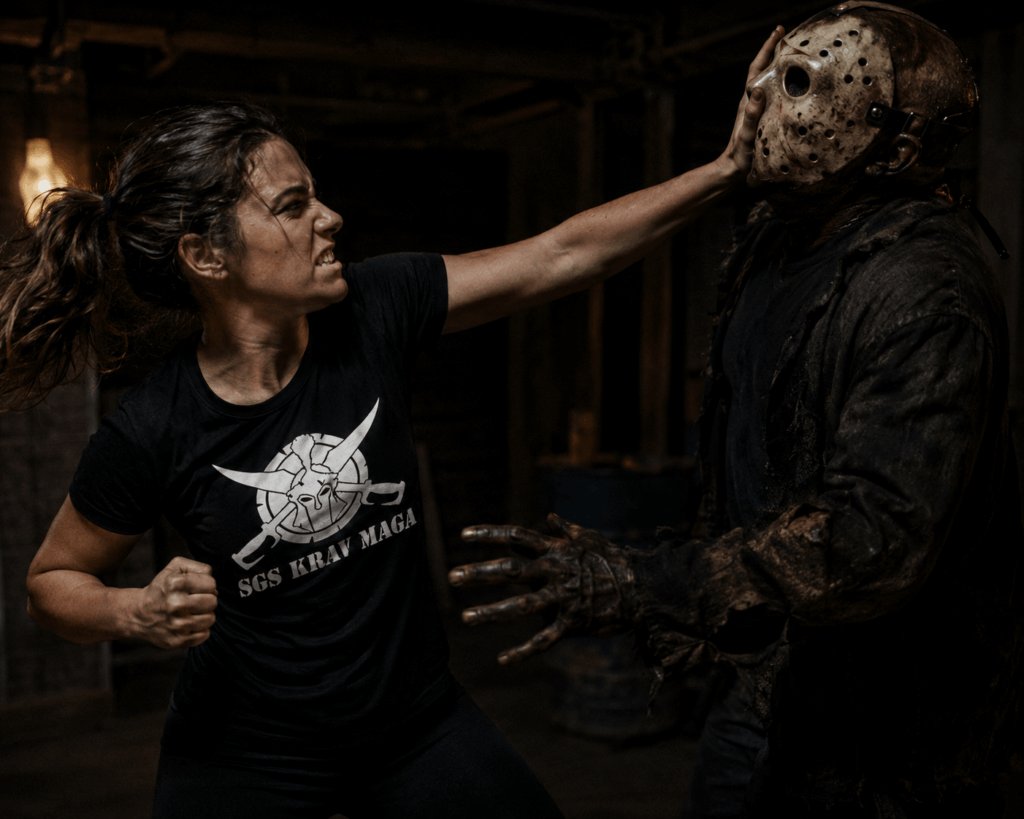
Could your Krav Maga training save you in a horror movie? While we hope you never have to test your self-defence skills against a masked villain, the situational awareness and practical techniques taught at SGS Krav Maga could make all the difference in a real-life emergency. It’s Friday night. You...
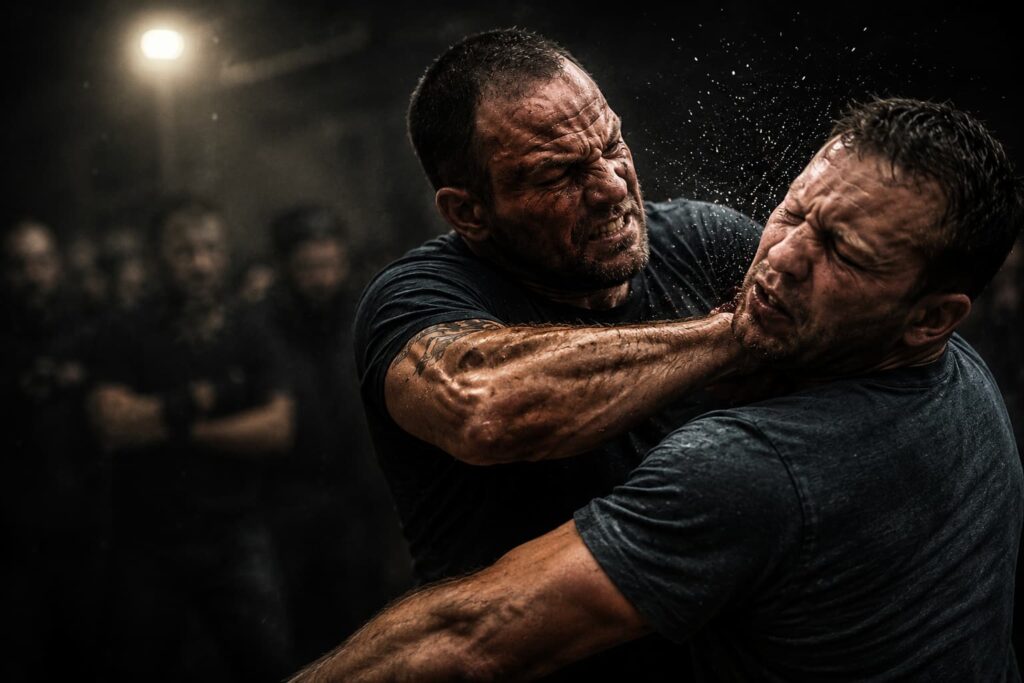
Picture this: You’re in a dark alley, some aggressive clown is coming at you, and you calmly press a secret spot behind his ear like you’re ringing a doorbell. Boom, he drops like a sack of potatoes, eyes rolling back, completely unconscious. You dust off your hands, wink at the...

At SGS Krav Maga in Sydney, self-defence training isn’t just about punches, drills, and sweat. It’s about mindset, identity, consistency, and growth. Over time, I’ve distilled my personal training philosophy into a set of principles — all beginning with the letter P. These aren’t motivational clichés. They’re practical mental tools...
Sorry not sorry. Bodybuilding is not self-defence. Confusing the two can get you hurt. Let’s say it loud for the guys flexing in the mirror right now: Having a big chest, 20-inch arms, and visible abs does NOT make you good at self-defence.In fact, it can sometimes make things worse....

In a world where confrontations arise unexpectedly, many people cling to hope that staying passive will decrease aggression. They think: “If I just stay calm and don’t fight back, the threat will pass.” “Maybe if I just don’t hit him and I just stay here nicely, he won’t hit me.”...
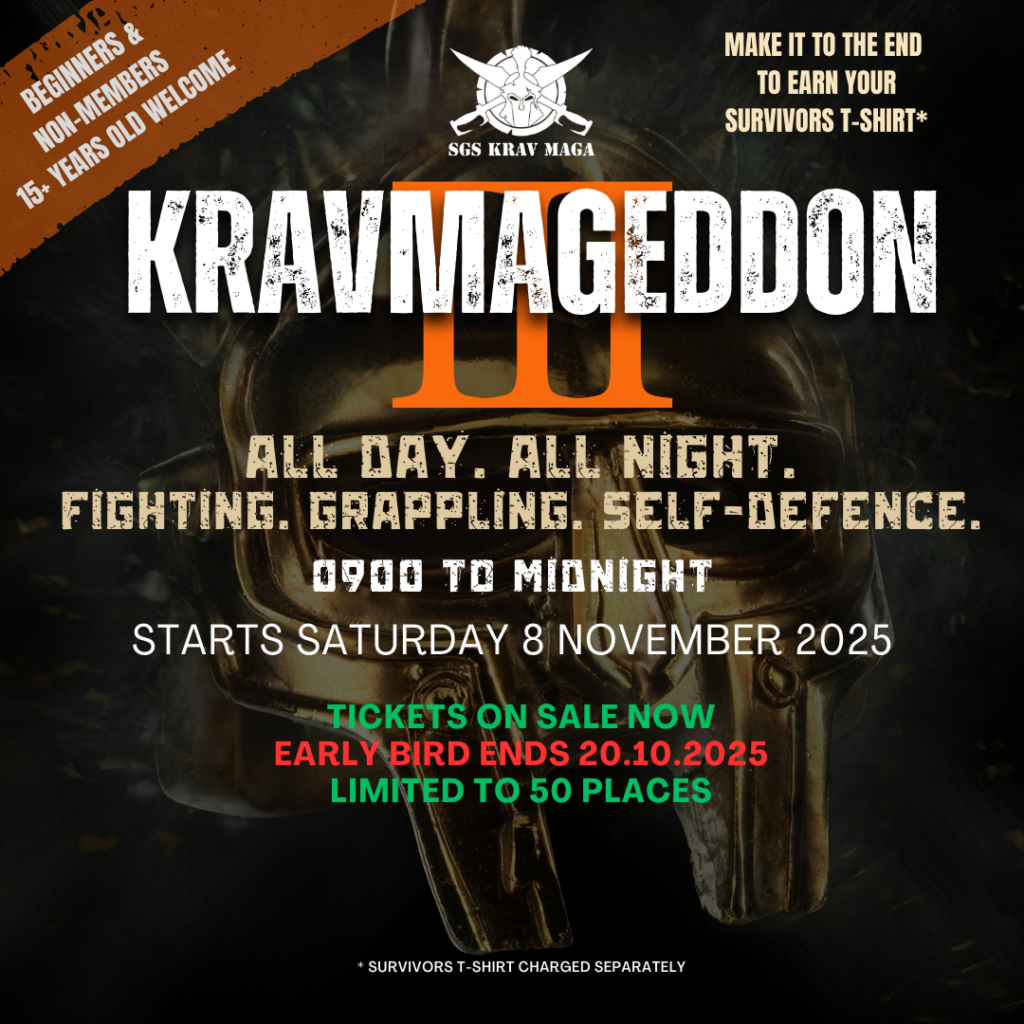
KRAVMAGEDDON IS BACK. 8 NOVEMBER 2024. Challenge yourself by completing 15 hours of non-stop fighting, self-defence, and grappling training. Starts 8 November 2025 @ 9.00amEnds 9 November 2025 @ 12.00am CLICK TO ACCEPT THE CHALLENGE Kravmageddon returns for the third year running on 8 November 2025. It’s designed to be the...
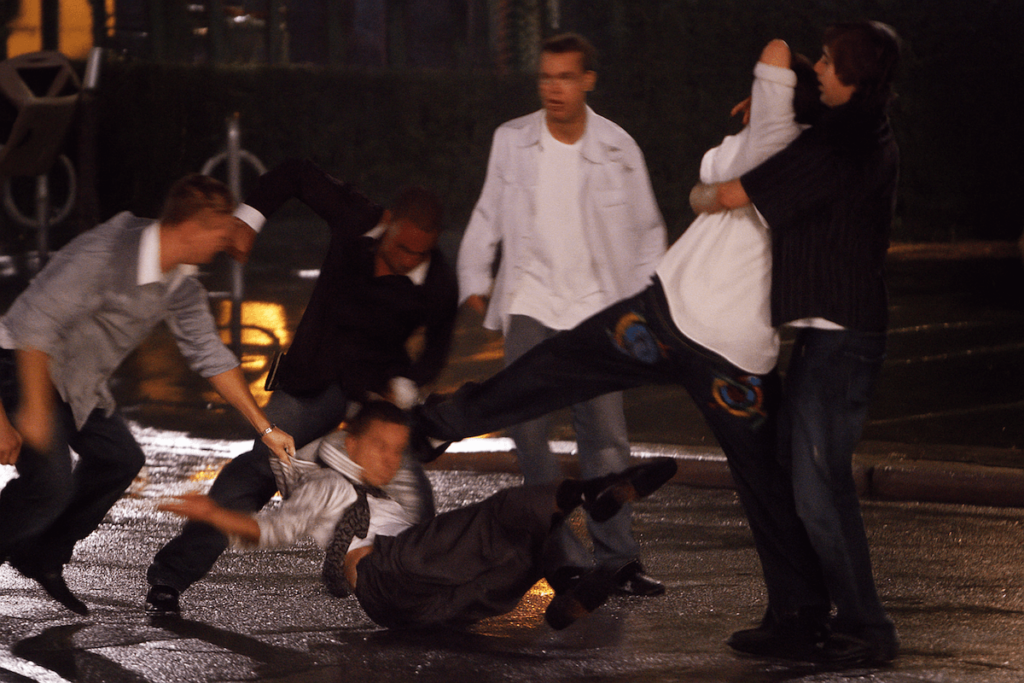
Brazilian Jiu-Jitsu (BJJ) is widely celebrated for its effective grappling techniques, leverage, and control in controlled environments. However, the harsh reality of street violence often introduces dangerous variables such as multiple attackers, weapons, and unpredictable tactics—including biting. The following real-world examples involving highly skilled BJJ black belts tragically illustrate how...
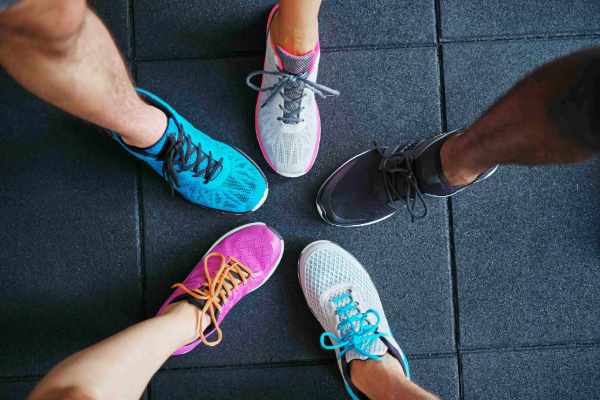
What are the best shoes for Krav Maga? We’re going to take a dive into the best shoes for training Krav Maga both for men and women. Training in Hybrid Krav Maga at SGS Krav Maga demands footwear that delivers stability, traction, and comfort without compromising agility. Your choice of...