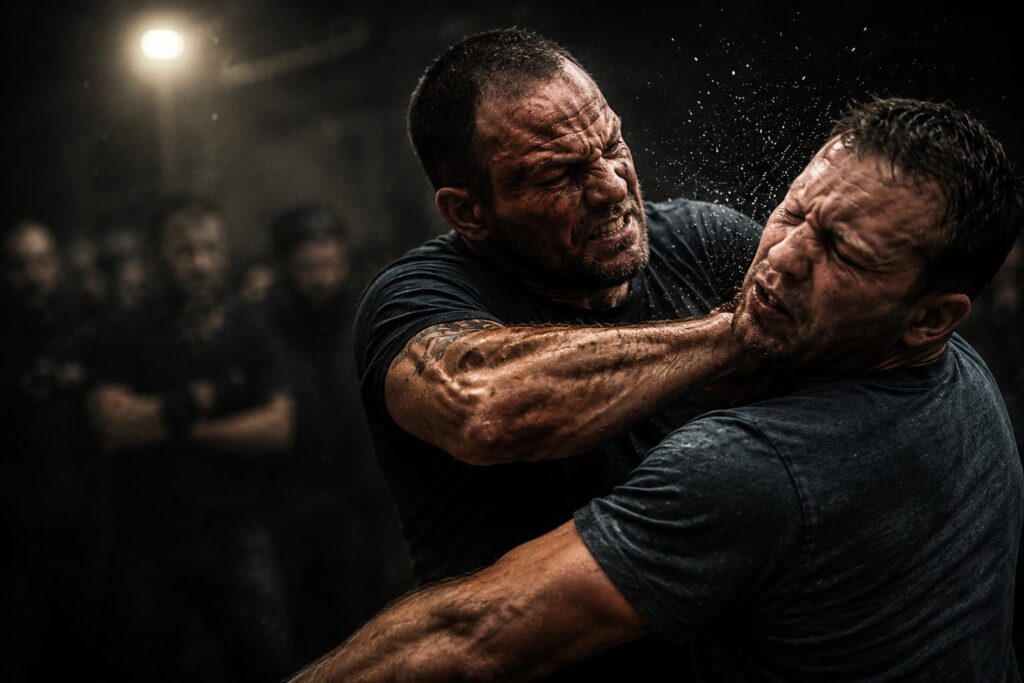
Picture this: You’re in a dark alley, some aggressive clown is coming at you, and you calmly press a secret spot behind his ear like you’re ringing a doorbell. Boom, he drops like a sack of potatoes, eyes rolling back, completely unconscious. You dust off your hands, wink at the camera, and walk away like a martial arts movie hero.
Sounds awesome, right?
Too bad it’s also a complete fantasy.
First – an important distinction you need to read
Before we go any further, let’s be absolutely clear about something, because this matters.
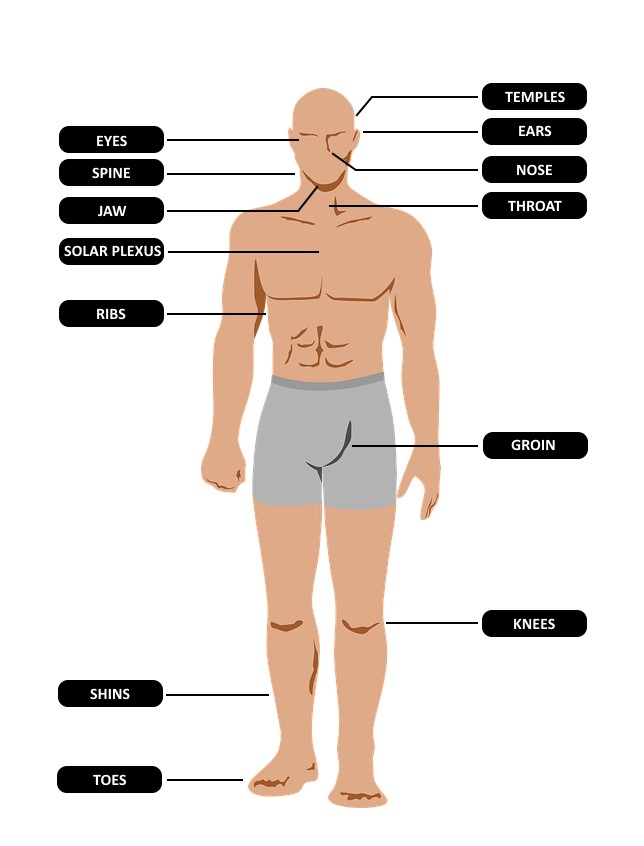
“9 Weak Points of the human body” is an article I worked really hard on, and it focuses on targets that can cause real pain and mechanical disruption when you hit them hard. It’s practical, combative thinking, not mystical wizardry.
A lot of people stumble across the “9 Weak Points of the Human Body” article and try to use it to verify some strange, mystical belief about ancient ninja pressure-point secrets. Suddenly, they’re convinced that with one perfectly aimed finger jab, they’ll drop any attacker effortlessly. Here’s the friendly but firm reality check: Believing in magic pressure points can get you seriously hurt. Some of you reading now may be getting quite upset
The Pressure Point Myth: Where it Comes From?
The idea is seductive. Learn a secret spot, apply a little pressure, and watch the attacker crumple. No strength required. No athleticism. No years of hard training on the mats. Just the right finger on the right spot at the right moment — and the threat is neutralised.
It sounds like the ultimate equaliser. And that’s exactly why people want to believe it.
The truth is, the pressure point myth has been quietly embedded into martial arts culture for decades. It shows up in traditional systems that treat certain nerve clusters and energy pathways as combat tools. It gets amplified by movie fight scenes where a single touch sends a grown man to the floor. It spreads through YouTube channels run by people who have never been punched in the face, demonstrating techniques on students who have been conditioned to fall on cue. And it finds a comfortable home in schools where no technique is ever truly pressure tested against genuine, uncooperative resistance.
The appeal is understandable. The idea that a smaller, physically weaker person can neutralise a larger, stronger, more aggressive attacker with a single precise touch is genuinely compelling — especially for people who feel vulnerable. It sells courses, it fills seminars, and it makes for impressive demonstration videos.
But there is a significant difference between something that looks good and something that works. And in self-defence, that difference is not academic — it is the difference between getting home safely and not.
Here’s your friendly but firm reality check: that belief can get you seriously hurt.
Pressure Points 101: The Non-Hollywood Version
To be clear, sensitive spots on the human body do exist. Poke someone in the eye and they’ll flinch. Drive a palm into the nose, and you’ll get watering eyes, pain, and probably some blood. A solid shot to the throat or groin can ruin someone’s day in a hurry.
But these aren’t “pressure points” in the mystical sense. They’re just vulnerable anatomy.
Practical, combative targets you can actually reach when things get ugly. Gross-motor, committed strikes, not delicate acupuncture-style fingertip touches.
The dangerous version? That’s when instructors or YouTube gurus promise instant, effortless knockouts using tiny nerve clusters with almost no force. The demo videos always feature a supremely compliant training partner who is, let’s be honest, basically acting.
In a real violent encounter? Not so much.
Why the Magic Fails When It Matters Most?
Adrenaline is a hell of a drug. When someone is raging, terrified, or just plain determined to hurt you, their body floods with chemicals that can make them almost impervious to pain. Add alcohol, drugs, or sheer psychotic energy into the mix, and your fancy pressure point technique might feel like a gentle shoulder massage.
Moving targets don’t cooperate. Real fights are not static. People are swinging, grabbing, yelling, and thrashing. Your fine-motor skills? Gone. Shaky hands and tunnel vision don’t exactly help you hit a 1cm sweet spot on a moving, violent human being.
Dojo demos versus street reality. That technique that looked devastating on your cooperative training partner? Try it on an athletic, aggressive attacker who is actively trying to take your head off. It buys you half a second at best, if you’re lucky.
“One-touch knockout” claims. Overhyped, highly situational, or straight-up nonsense when tested under real pressure. Relying on them is like planning to win the lottery for your retirement.
THE HARD TRUTH SOME PEOPLE WON’T WANT TO HEAR
Some of you reading this are getting upset right now. Maybe you’ve spent years training pressure-point techniques. Maybe your sensei swears by them. Loyalty to your instructor is admirable, but loyalty should never come at the cost of your safety.
Here’s the straight talk: if a technique only works on a willing training partner in a controlled environment, it is not self-defence. It’s theatre.
Real respect for your training means being honest about what works and what doesn’t. Your life may one day depend on that honesty.
The Real Danger of Believing The Hype
Thinking you have a secret “off switch” for attackers creates a dangerous kind of overconfidence. You might skip building solid, aggressive self-defence skills. You might hesitate when the magic button fails, and in a real confrontation, hesitation can turn a bad situation into a catastrophic one.
Misplaced confidence is not the same as being prepared.
What Actually Works
Effective self-defence isn’t about finding the perfect pressure point. It’s about:
Aggressively targeting obvious vulnerable areas: eyes, throat, nose, groin; with power and commitment
Using those strikes to create an opening and get out, not to “win” a fight
Training under stress so your gross-motor skills actually show up when adrenaline hits
Having one clear mindset: do whatever it takes to escape safely
Pressure points can be useful as distraction tools, a way to buy a second, create pain, and create distance. But treat them like a party trick, not a life insurance policy.
Train Smart. Train Real. Train at SGS.
At SGS Krav Maga, we don’t teach fairy tales. We teach reality-based self-defence built on what actually works when it counts, under stress, against a resisting attacker, in the real world.
Our instructors have decades of combined experience teaching men, women, kids, and teens how to defend themselves using practical, proven techniques. No mystical finger jabs. No compliant training partners. No Hollywood nonsense.
If you’re ready to train in something that could genuinely save your life, we’d love to have you on the mats.
Walk past almost any karate, taekwondo, kung fu, boxing, kickboxing, or BJJ school and you’ll see the same banner in the window: “Self-Defence Classes for All Ages.” It’s a nice sentence. It sells memberships. Parents feel better. Kids feel tougher. Everyone leaves happy. There’s just one problem: for most schools...
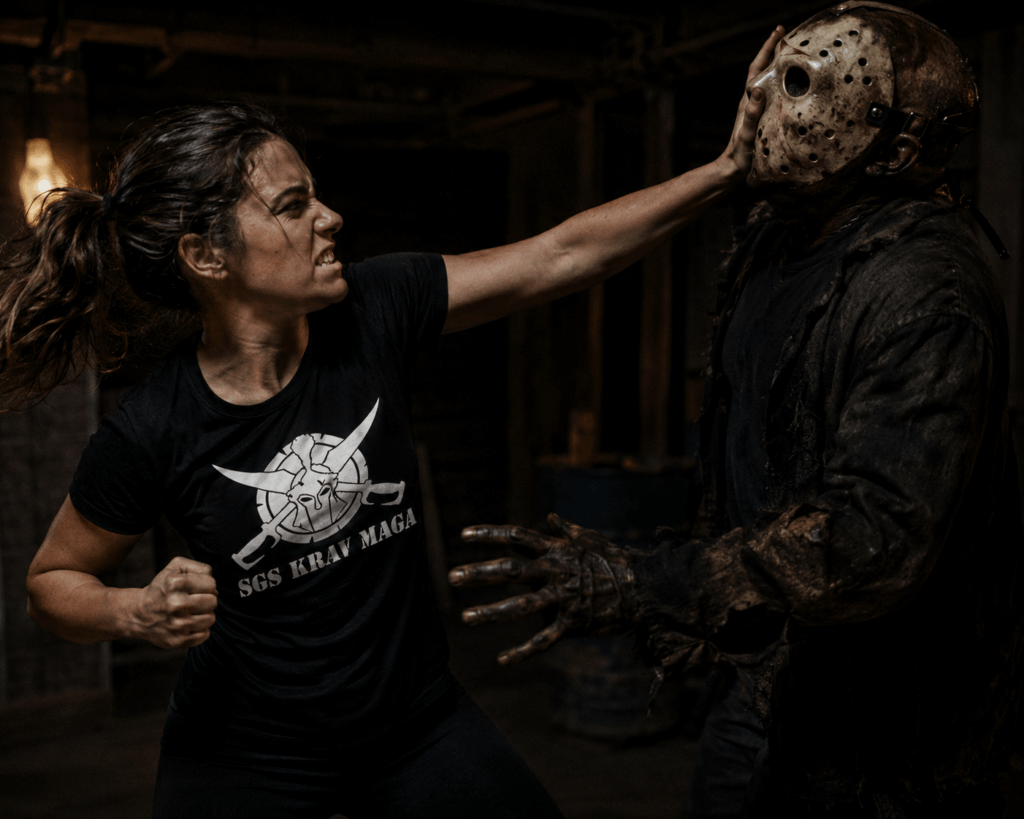
Could your Krav Maga training save you in a horror movie? While we hope you never have to test your self-defence skills against a masked villain, the situational awareness and practical techniques taught at SGS Krav Maga could make all the difference in a real-life emergency. It’s Friday night. You...
Picture this: You’re in a dark alley, some aggressive clown is coming at you, and you calmly press a secret spot behind his ear like you’re ringing a doorbell. Boom, he drops like a sack of potatoes, eyes rolling back, completely unconscious. You dust off your hands, wink at the...
At SGS Krav Maga in Sydney, self-defence training isn’t just about punches, drills, and sweat. It’s about mindset, identity, consistency, and growth. Over time, I’ve distilled my personal training philosophy into a set of principles — all beginning with the letter P. These aren’t motivational clichés. They’re practical mental tools...
Sorry not sorry. Bodybuilding is not self-defence. Confusing the two can get you hurt. Let’s say it loud for the guys flexing in the mirror right now: Having a big chest, 20-inch arms, and visible abs does NOT make you good at self-defence.In fact, it can sometimes make things worse....
In a world where confrontations arise unexpectedly, many people cling to hope that staying passive will decrease aggression. They think: “If I just stay calm and don’t fight back, the threat will pass.” “Maybe if I just don’t hit him and I just stay here nicely, he won’t hit me.”...
KRAVMAGEDDON IS BACK. 8 NOVEMBER 2024. Challenge yourself by completing 15 hours of non-stop fighting, self-defence, and grappling training. Starts 8 November 2025 @ 9.00amEnds 9 November 2025 @ 12.00am CLICK TO ACCEPT THE CHALLENGE Kravmageddon returns for the third year running on 8 November 2025. It’s designed to be the...
Brazilian Jiu-Jitsu (BJJ) is widely celebrated for its effective grappling techniques, leverage, and control in controlled environments. However, the harsh reality of street violence often introduces dangerous variables such as multiple attackers, weapons, and unpredictable tactics—including biting. The following real-world examples involving highly skilled BJJ black belts tragically illustrate how...
What are the best shoes for Krav Maga? We’re going to take a dive into the best shoes for training Krav Maga both for men and women. Training in Hybrid Krav Maga at SGS Krav Maga demands footwear that delivers stability, traction, and comfort without compromising agility. Your choice of...
SGS Krav Maga Welcomes Tommy Blom, Head of Hybrid Krav Maga, for His First-Ever Australia Visit From Friday 11 July through Thursday 17 July 2025, SGS Krav Maga will host Tommy Blom—Global Director and Head Instructor of Hybrid Krav Maga—for an intensive HKM Instructor Course, culminating in a public workshop...